

Lisbon property market 2026: smart investment or has the moment passed?
In 2025, Lisbon remained on the global capital radar - and in 2026 the right question isn't “how much has it gone up?”, but “where and as buying with numbers that make sense?”. This guide focuses on the centre of Lisbon (Avenidas Novas, Santo António/Príncipe Real/Chiado, Misericórdia, Lapa/Estrela, Campo de Ourique, Parque das Nações), where prices, rents and yields differ materially from the rest of the district.
Summary
- Market accelerated in 2025: Portugal saw record year-on-year rises in the 2nd quarter (+19% in the median price; INE via ECO). In Lisbon city, average order ~4.454 €/m² (Sep/2025; Idealist). In the prime, several parishes >5,000 €/m² (Idealist News).
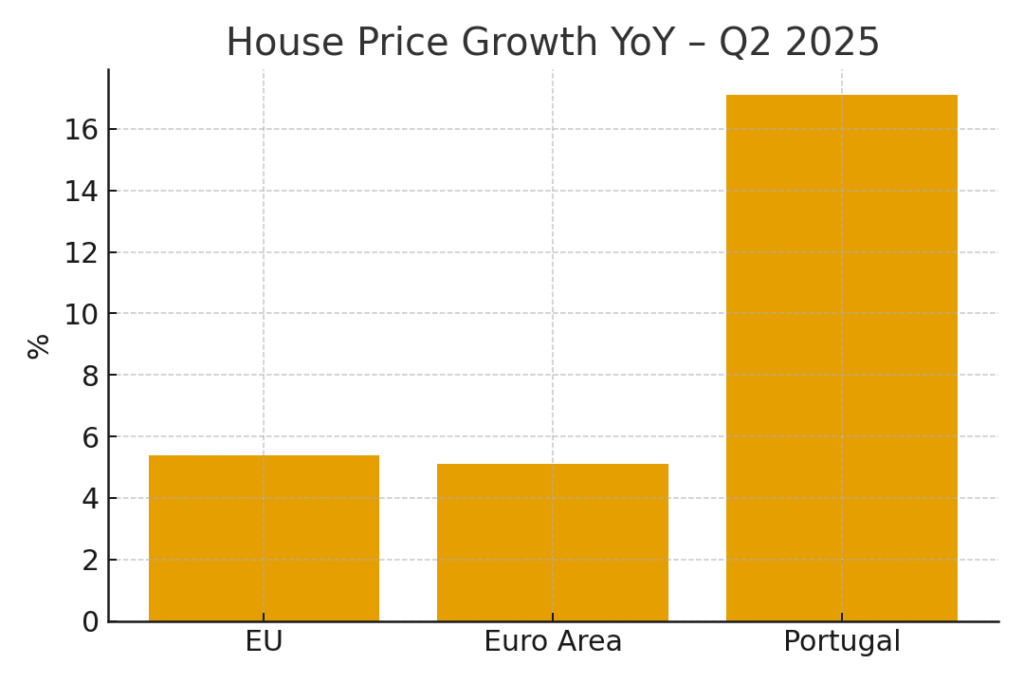
- Macro context: Eurostat points to rising prices in the EU (+5.4% YoY in Q2 2025) with Portugal among the highlights (Eurostat). The ECB cut rates throughout 2025, easing instalments with phased effects (FT | Reuters). The search for credit increased in spring 2025 (Bank of Portugal).
- Lisbon Fundamentals: safety (Portugal Top-10 in GPI 2025), quality of life and limited supply in the centre support prices (GPI). Construction costs still on the rise (+3.9% YoY Jun/2025; INE) e timelines long licensing periods (120-200 days; Chambers).
- 2026 - base case: Lisbon city centre with stabilisation to slight gain (+1% to +5%); moderate upside (+6% to +9%) if ECB cuts continue and external demand is maintained; limited downside (-3% to -5%) under macro/political shock. See scenarios section.
Where we are in 2025 (Central Lisbon)
The year was marked by a generalised acceleration in prices in Portugal: the median transaction price reached 2.065 €/m² in the 2nd quarter (+191TP3Q YoY), a new all-time high (INE via ECO; RTP/Lusa). In Lisbon (municipality), the average asking price reached ~4.454 €/m² in September (Idealist). At European level, the Eurostat reports a 5.4% rise in prices (EU, Q2 2025), with Portugal among the most dynamic markets.
Growth engines (2015-2025) that still count
1) International demand and security
Portugal remains in the world top-10 for peace/security (GPI 2025), anchor factor for families and HNWI (GPI). This stability, combined with the climate, international schools and connectivity, sustains demand in the centre.
2) Demographics and positive net migration
The country has returned to grow in population (+109.9 thousand residents in 2024 vs. 2023), with a strong weight of the AML (INE). AIMA points to an upward revision of foreign residents (AIMA/INE).
3) Financing: ECB cuts and recovery in demand for credit
In 2025, the ECB reduced the key rate (to around 2.25-2.50% in the spring), signalling gradual relief in the cost of debt (FT | AP). O Bank of Portugal reported growing demand for home loans in spring. The effect on prices is out of date, but visible in the proposals.
4) Limited supply in the centre: permits and construction costs
Municipal licence deadlines typically vary between 120 and 200 days according to the gross area, preventing rapid supply responses in the core (Chambers). In parallel, the construction costs rose ~3.9% YoY in June/2025 (INE), keeping pressure on the final price.
5) Short-term rental regulation (AL)
More restrictive national and municipal rules have reduced the elasticity of the tourist offer in mature areas - less competition for property prime can sustain residential values (see AL 2025 Guide - Turismo de Portugal).
What could stabilise or cause prices to fall in 2026 (and how likely)
- ECB rate hikes pause/resume (low-medium prob.): a re-accelerated inflation scenario could put the brakes on cuts and put pressure on instalments; greater impact on the leveraged segment, less on HNWI (Reuters/ECB).
- European macro shock (weak growth/exports) (medium): loss of confidence reduces second home transactions; effect mitigated by Lisbon's “safe harbour” status and diversified demand.
- Tax changes less favourable to foreign investors (low-medium): the end of the classic NHR and the IFICI (NHR 2.0) re-focused benefits (KPMG | CGD), but non-fiscal motivators (safety, schools, climate) sustain demand.
- Standardisation in “fashion zones” (medium): data shows occasional corrections in 2025 (e.g. retreats in Arroios), especially after strong rises (ECO). It's rotation, not collapse.
- Positive supply surprise (low): even with the pipeline in Oriente/Parque das Nações, the combination of costs and licences limits generalised falls in the historic centre.
Demand (who buys and why)
In terms of the number of transactions, the resident buyer remains dominant; the international buyer contributes tickets and is looking for assets with proven scarcity (top floors with terraces, views, parking and lifts in classic buildings). International schools, mobility (metro/train), security and neighbourhood life anchor the decision. Signs of improvement in access to credit can be seen in the Bank of Portugal.
Offer and licence
The new offer in central Lisbon is structurally limited: protected buildings, block morphology, height restrictions and lengthy licensing processes. For a framework, see CML (town planning) and practical guides to deadlines/procedures (Chambers).
Rents and yields
In central Lisbon, the yield headline are lower than in the rest of the country, offset by lower vacancy rates, a better tenant profile and liquidity on exit. For comparable rents, use searches by neighbourhood in the Idealist, reports of Savills and Knight Frank, and independent bases such as Global Property Guide.
Micro-markets: how to position capital
Santo António / Príncipe Real / Chiado (Avenida da Liberdade, Misericórdia)
The “golden triangle” in the centre of Lisbon. Look for buildings with lifts and parking (rare), top floors with terraces, views of the Tagus, and renovations with documented engineering. Profile: capital preservation with upside in assets trophy.
Lapa / Estrela
Classic, residential, diplomatic. Terraces to the west and interior gardens at a premium. Check licences, infrastructure (water/AVAC) and condominium minutes. Profile: stable yield + moderate appreciation.
Avenidas Novas / Saldanha / Campo Pequeno
Efficient plant, mobility and services; strong demand for corporate rentals. Good relations risk/return in post-2000/deep rehabilitated product.
Campo de Ourique
Neighbourhood living and nearby shops; a product with a balcony/parking space is an exception and adds value. Strict filter for carpentry and acoustics.
Parque das Nações / Oriente
Recent property stock, facades facing the river, schools and accesses; shops and services; predictable maintenance and low vacancy in families/expats. Profile: buy-to-let defence.
Scenarios 2026 (Lisbon city centre)
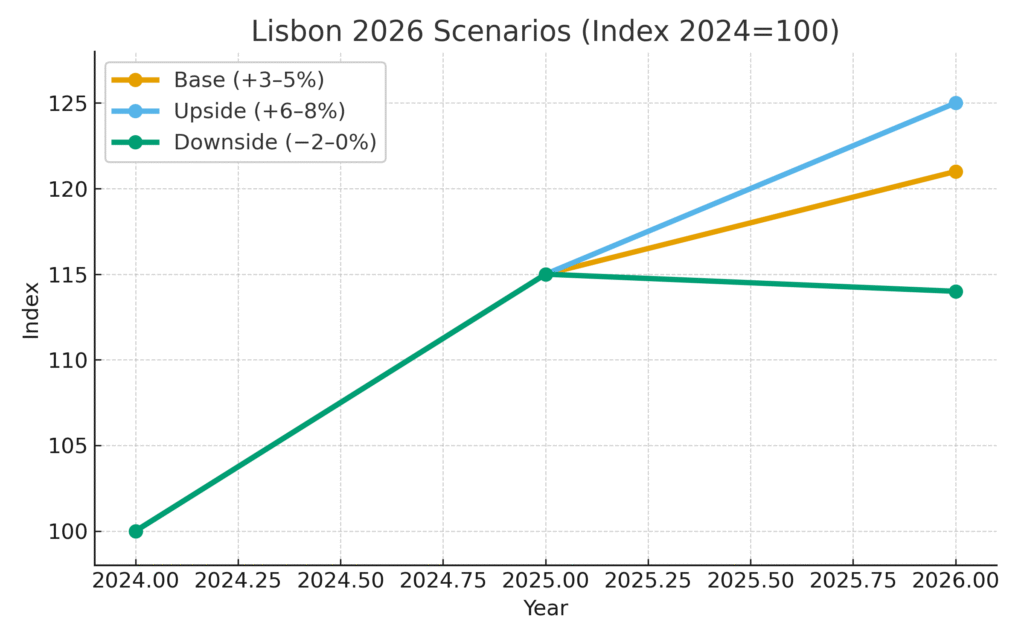
- Base (55%): “more technical” market, stable volumes, prices +1% to +5%; resilient prime incomes (global eco Savills) reinforce yield in well-localised assets.
- Upside (35%): additional ECB cuts and strong external demand → +6% to +9% in prime locations and top rehabilitations, with compression of yields.
- Downside (10%)macro/tax shock + regulatory uncertainty → -3% to -5%, In particular, in medium-sized assets without sun exposure/parking/elevator/etc. Prime suffers less.
“All-in numbers” before the proposal (to avoid surprises)
Before setting the price you're going to offer, calculate the total cost: IMT, IS, lawyer, registration, valuation, credit stamp duty, bank commissions and works. Keep a contingency of 5-10% in case of rehabilitation. If you use finance, include evaluation condition and credit condition in the CPCV with realistic deadlines and exit conditions.
Useful reading: Taxes & costs when buying - Financing for foreigners - CPCV: how to protect yourself - Deed checklist.
Indicators to monitor in 2026
- ECB key rate and bank spreads (credit conditions: BdP BLS).
- INE/Eurostat: price rhythm (transaction) vs. order (portals) - signs of divergence (Eurostat | INE).
- Construction costs and licence (elasticity of supply: INE ICC | Chambers).
- AL rules and taxation for new residents (IFCI/NHR 2.0: KPMG | CGD | Turismo de Portugal).
FAQ (for investors)
Are the prices in the centre of Lisbon too expensive?
They are at all-time highs, as they have been every year since around 2015, but some areas, such as the centre, are in short supply and provide a more defensive investment. In 2026 we expect stabilisation to slight gains (+1-5%). In surgical purchases, the risk of structural correction is lower. Here's some data on property sales in Lisbon: Idealist.
Has the end of the NHR reduced international demand?
The broad incentive has been reduced; the IFICI (NHR 2.0) has repositioned itself towards more qualified profiles. Nonetheless, non-fiscal motivators (security, schools, climate) sustain demand in the upper-middle segment (KPMG | CGD).
Is it better to buy prime or “relative value” in neighbourhoods in transition?
It depends on the objective: to capital preservation look for well-established neighbourhoods or streets in a prime market (Av. Novas, São Sebastião, Chiado, Lapa, etc.); for risk-adjusted return → streets or specific parts of certain neighbourhoods (e.g. Marvila/Beato/Anjos) with high quality construction and good physical layout (light, insulation, parking).
How to avoid surprises CPCV if I'm going to use financing?
Include credit condition and evaluation condition with clear deadlines. If the valuation falls short, the contract dictates: renegotiation, alternative, or exit without losing a deposit. Read more: CPCV in Portugal.
What is the price difference between the centre and the outskirts today?
Lisbon city ~4.454 €/m² (request Sept/2025); several parishes prime >5,000 €/m² (Idealist). AML has lower medians; always compare by parish.
Related reading: Lisbon 2025: smart investment or safe harbour? - Cascais & Estoril: luxury market - Buy to let - AL: what has changed and alternatives.
We can help. We work only for buyers - independent search, technical due diligence and calm negotiation. Get to know us Buyer's Agency or Schedule a Call. Download Buyer's Guide and see testimonials.
Main sources: Idealist - Lisbon county - INE via ECO - Eurostat HPI Q2/2025 - BdP - Bank Lending Survey - Savills World Cities H1 2025 - Knight Frank - Prime Global - INE - Construction Cost Index - Chambers - Licensing - Turismo de Portugal - AL 2025.

 Português
  English (UK)